Harvests Worth Keeping: The American Chocolatiers Cataloging Their Bars by Year
For most of its modern history, chocolate has been understood as a perishable—something to be consumed promptly, ideally before the bloom sets in or the fat migrates to the surface. Best-by dates exist not as suggestions but as verdicts. Yet a small and growing cohort of American craft chocolatiers is challenging that assumption with the seriousness of archivists and the patience of vintners.
They are cataloging their bars by year. They are building cellars. They are speaking, with increasing precision, about peak windows and off-vintage anomalies. And they are finding, in the process, that chocolate's relationship with time is far richer and stranger than conventional wisdom has permitted.
The Vintage Concept, Translated
The analogy to wine is imperfect but instructive. In viticulture, a vintage year encodes the specific climatic and environmental conditions of a single growing season—conditions that express themselves in the glass years or even decades later. The concept presupposes that the raw material carries within it a kind of temporal signature, one that unfolds gradually under the right conditions.
Cacao, it turns out, operates similarly. The fermentation conditions at origin, the moisture levels during drying, the precise temperature curve of the roast, the duration of conching—each of these variables imprints itself on the finished bar in ways that continue to evolve long after production. What a bar tastes like at six months may bear only a family resemblance to what it offers at three years.
Some makers have begun affixing harvest years rather than production dates to their packaging, a subtle but meaningful distinction. The harvest year reflects the origin of the cacao itself—the season in which those particular pods were opened, those beans fermented and dried—rather than the date the bar was tempered and wrapped. For these producers, the bar is less a manufactured product than a preserved expression of a specific agricultural moment.
What Changes in the Cellar
The chemistry of chocolate aging is not fully mapped, but researchers and makers have identified several reliable trajectories. Tannins, which contribute to astringency in younger bars, tend to polymerize over time, softening the palate experience and allowing subtler fruit and floral notes to emerge. Volatile aromatic compounds shift in their relative concentrations, sometimes revealing secondary and tertiary flavors that were entirely absent or suppressed in the fresh bar.
Acidity, often a dominant feature of bars made from high-altitude Peruvian or Ethiopian-origin cacao, generally mellows with extended storage—a transformation that some tasters find revelatory and others find diminishing, depending on their preference for brightness. The fat matrix of well-tempered dark chocolate stabilizes over time, contributing to what experienced tasters describe as a more integrated, seamless mouthfeel.
Not every bar ages gracefully. Lower-percentage milk chocolates, with their higher dairy fat content, are far more vulnerable to oxidation and off-flavors. Even among dark bars, the quality of tempering, the integrity of the packaging, and the consistency of storage temperature determine whether time becomes an ally or an adversary.
The Conditions That Make It Possible
Proper cellaring of chocolate is not a casual undertaking. The ideal environment maintains a temperature between 60 and 65 degrees Fahrenheit with relative humidity kept below 55 percent—conditions that most American households do not naturally provide, particularly during summer months. Exposure to light, to strong odors, or to significant temperature fluctuation can arrest or corrupt the aging process entirely.
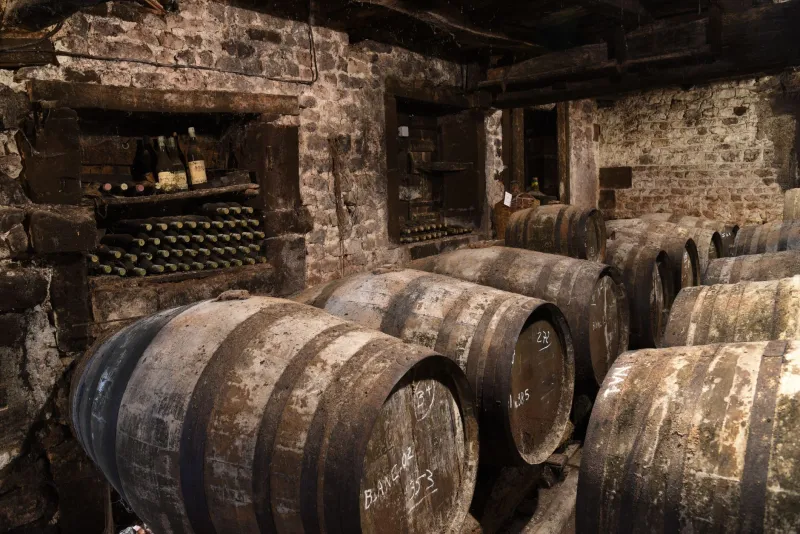
Some makers have begun constructing dedicated aging environments within their production facilities, modeled loosely on wine caves or cheese-aging rooms. These spaces are monitored with the same instruments used in pharmaceutical cold storage, with temperature and humidity logged continuously. The investment is substantial, and the returns are not immediate—but for makers committed to the vintage model, it is understood as foundational infrastructure.
A smaller number of dedicated consumers have begun building their own chocolate cellars, often repurposing wine refrigerators or humidity-controlled cigar humidors. Among this community, the exchange of tasting notes on aged bars has taken on the character of a serious connoisseurial practice, with the same vocabulary of development, peak, and decline that attends fine wine discussion.
Peak Windows and the Question of Patience
Perhaps the most provocative concept imported from viticulture is that of the peak drinking window—the period during which a given vintage is considered to express its full potential. Applied to chocolate, this idea requires makers and consumers alike to resist the immediate gratification that the medium has always promised.
Some chocolatiers are now publishing informal tasting notes at six-month intervals for their cellared bars, tracking the arc of flavor development and offering guidance on when a particular production might be at its most expressive. A bar that tastes austere and tannic at production may be described as entering its peak at eighteen months, with a window extending to three or four years before certain volatile aromatics begin to fade.
This language is unfamiliar to most American chocolate consumers, accustomed as they are to regarding a bar as either fresh or past its prime. But for those who have tasted a well-cellared bar alongside its younger counterpart, the difference is often striking enough to reframe the entire category.
What This Movement Reveals
The vintage movement in American craft chocolate is, at its core, an argument about the nature of the medium itself. It insists that chocolate is not merely a confection but an agricultural product with a life that extends well beyond its manufacture—one that rewards attention, patience, and the kind of longitudinal curiosity that fine wine has long demanded of its devotees.
For the makers involved, it also represents a deepened relationship with their source material. To cellar a bar made from a particular farm's 2021 harvest and taste it again in 2026 is to maintain a living record of a specific place and season—a form of preservation that is simultaneously sensory and historical.
The American craft chocolate movement has spent two decades establishing that the bar is worthy of serious consideration. The vintage experiment suggests the conversation is only beginning.