What the Bean Cannot Tell You: The Quiet Alchemy of Chocolate Aged Beyond Its Harvest
There is a particular kind of reverence that surrounds the origin story in American craft chocolate. The farm name, the harvest season, the precise altitude at which the cacao was cultivated — these details have become the primary vocabulary through which connoisseurs evaluate a bar before it ever reaches the palate. Yet a compelling counter-argument has been gathering force in workshops from Vermont to California: the story of where a bar was born may matter considerably less than what happens to it in the years that follow.
For a generation of American chocolatiers, time itself has become an ingredient — one that no terroir claim, however specific, can replicate or replace.
The Limits of Provenance
Single-origin chocolate has accomplished something genuinely important. It elevated cacao from a commodity ingredient into a subject worthy of serious attention, drawing comparisons to fine wine and specialty coffee. The movement encouraged consumers to think about flavor as a function of place, and it created meaningful economic relationships between North American producers and farming communities abroad.
But provenance, as a framework, has a ceiling. A bar sourced from a celebrated Peruvian valley or a storied Madagascan cooperative arrives with its geographical credentials intact — and yet those credentials describe only the conditions of the bean's beginning, not the arc of its development. Harvest timing and soil composition establish a flavor potential. What the chocolatier does with time determines whether that potential is ever fully realized.
"We've become very good at talking about where chocolate comes from," observes one small-batch producer based in the Hudson Valley. "We're only beginning to get serious about what it becomes."
Oxidation as Orchestration
At the molecular level, a finished chocolate bar is not static. From the moment tempering is complete and the bar is wrapped, a slow choreography of chemical reactions begins. Lipid oxidation — the gradual interaction between the cocoa butter's fatty acids and ambient oxygen — progressively modifies aromatic compounds. Polyphenols, the antioxidant-rich molecules responsible for much of dark chocolate's complexity, continue to polymerize, softening the sharp edges of astringency and deepening what tasters describe as the "base note" of a bar.
This is not spoilage. Properly managed, it is transformation.
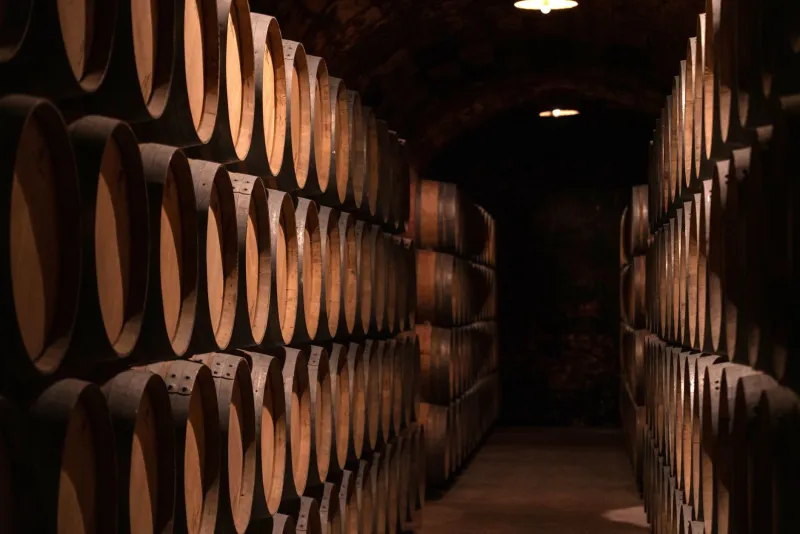
The distinction matters enormously. Uncontrolled oxidation, the result of poor storage or inadequate packaging, produces the stale, waxy off-notes familiar to anyone who has encountered neglected supermarket chocolate. Controlled aging — executed with attention to temperature, humidity, and oxygen exposure — is something categorically different. It is, in essence, the chocolate equivalent of barrel aging in the spirits world or extended cave maturation in fine cheese production.
The American Cellaring Movement
A small but increasingly visible cohort of American craft producers has begun building what might be called a cellaring philosophy into their production model. Rather than releasing bars immediately after production, these makers hold finished inventory under carefully regulated conditions, revisiting and tasting at intervals of three, six, twelve, and sometimes twenty-four months. The bars released to the public are chosen not by production date alone, but by the judgment that a particular batch has arrived at an optimal stage of development.
The practical logistics are not trivial. Dedicated aging rooms require precise climate control — typically maintained between 60 and 65 degrees Fahrenheit with relative humidity held below 55 percent. The investment in storage infrastructure, combined with the opportunity cost of inventory held off the market, means that aged chocolate commands — and, many would argue, deserves — a premium that exceeds even the most celebrated single-origin releases.
For the discerning consumer, the payoff can be revelatory. A bar tasted at three months and again at eighteen months from the same production batch can present as an almost entirely different experience. The brighter, more volatile fruit notes that characterize freshly produced dark chocolate — the raspberry and citrus top notes that single-origin advocates often celebrate as evidence of terroir — gradually yield to deeper, more integrated expressions: dried stone fruit, tobacco, forest floor, and a lingering mineral resonance that no freshly made bar can manufacture.
Rethinking the Vintage Concept
The wine analogy is imperfect but instructive. In the wine world, vintage variation — the year-to-year differences in climate that shape a harvest — is understood as one dimension of quality, not the only one. A great Burgundy from a mediocre year, properly cellared, will frequently outperform a mediocre Burgundy from a celebrated vintage released too early. The winemaker's stewardship of time is as consequential as the vineyard's geography.
Chocolate's relationship with vintage has historically been far less nuanced. Most bars carry a "best by" date that functions as an expiration warning rather than a maturation guide, implicitly framing age as a liability rather than an asset. The craft movement has begun to challenge this framing, but the shift in consumer perception remains incomplete.
Some producers have begun printing dual date information on their packaging — production date alongside an optimal tasting window — a practice borrowed loosely from the natural wine world and intended to reframe the consumer's relationship with the bar as an evolving object rather than a perishable one.
What the Palate Learns
There is an educational dimension to this conversation that deserves acknowledgment. Tasting aged chocolate alongside its freshly produced counterpart is one of the most instructive exercises available to the serious enthusiast. The experience makes viscerally apparent what abstract chemistry can only describe: that flavor is not fixed at the point of production, and that patience — both the maker's and the consumer's — is a form of craft in its own right.
For those accustomed to evaluating chocolate primarily through the lens of origin, the encounter with a well-aged bar can be genuinely disorienting. The flavors no longer announce their geography with the same clarity. What emerges instead is something harder to categorize and, for many tasters, considerably more compelling: a complexity that feels earned rather than inherited, a depth that no harvest story can fully account for.
A More Complete Vocabulary
None of this is to suggest that provenance is irrelevant. The cacao bean's origin continues to establish the foundational character from which all subsequent development proceeds. A bean with inherent brightness will age differently than one with a naturally earthy profile; the chocolatier who understands both the genetic and geographical history of their cacao is better equipped to predict and manage the aging trajectory.
But the craft chocolate world's vocabulary will remain incomplete as long as the harvest date is treated as the primary marker of a bar's identity. Age, in the hands of a skilled maker, is not the enemy of freshness — it is the condition under which a bar's most complex self finally becomes legible.
The terroir of time is, in this sense, the final frontier of American craft chocolate. It asks more of both producer and consumer: more patience, more attentiveness, more willingness to return to the same bar over months and find it changed. The reward, for those inclined to look, is a depth of experience that no origin story, however compelling, can manufacture on its own.